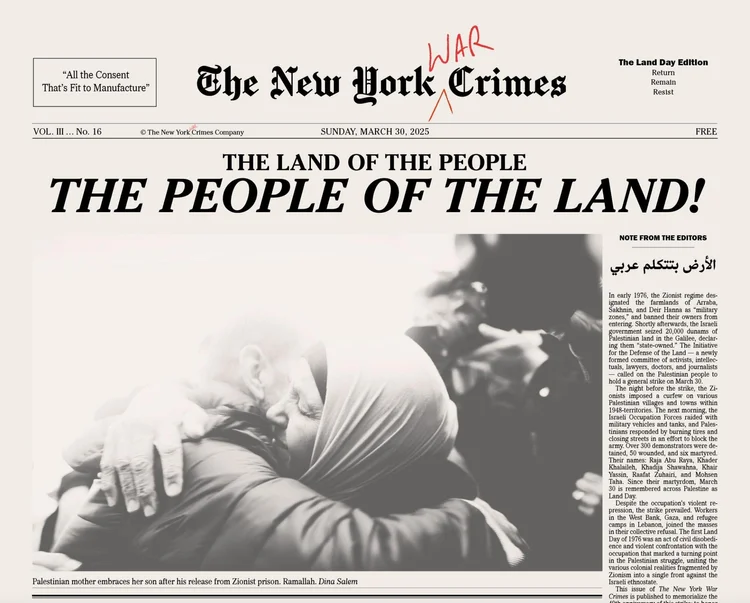
To our friends,In early 1976, the Zionist regime designated the farmlands of Arraba, Sakhnin, and Deir Hanna as “military zones,” and banned their owners from entering. Shortly afterwards, the Israeli government seized 20,000 dunams of Palestinian land in the Galilee, declaring them “state-owned.” The Initiative for the Defense of the Land — a newly formed committee of activists, intellectuals, lawyers, doctors, and journalists — called on the Palestinian people to hold a general strike on March 30. The night before the strike, the Zionists imposed a curfew on various Palestinian villages and towns within 1948-territories. The next morning, the Israeli Occupation Forces raided with military vehicles and tanks, and Palestinians responded by burning tires and closing streets in an effort to block the army. Over 300 demonstrators were detained, 50 were wounded, and six were martyred: Raja Abu Raya, Khader Khalaileh, Khadija Shawahna, Khair Yassin, Raafat Zuhairi, and Mohsen Taha. Since their martyrdom, March 30 is remembered across Palestine as Land Day. Despite the occupation’s violent repression, the strike prevailed. Workers in the West Bank, Gaza, and refugee camps in Lebanon joined the masses in collective refusal. The first Land Day of 1976 was an act of civil disobedience and violent confrontation with the occupation that marked a turning point in the Palestinian struggle, uniting the various colonial realities fragmented by Zionism into a single front against the Israeli ethnostate. W.A.W.O.G. published the newest issue of The New York War Crimes, the Land Day Edition, to memorialize the 49th anniversary of this strike: to honor the martyrs, the resistance, and the land that is inextricably linked to Palestinian freedom. The struggle against Zionism neither began nor ended on March 30, 1976, but 49 years later Land Day still serves as a crucial reminder of the long lineage of resistance that our movement must carry forward. The issue is not interested in a diasporic romanticization of Arab land (its seas and its mountains, the olive trees and orange groves). Instead, the pieces in this issue insist that the land and struggle are one: that to free the land, we must free the people. True liberation means land back; it means returning Palestine’s natural resources to its rightful owners; it means seizing the means of production from the Zionists and the comprador class. By their very existence, Palestinians shatter the Zionist fantasy that the land belongs to those that own it, insisting instead that it belongs to those that steward it. Despite the 2,000-pound bombs and white phosphorus that Israel drops on the besieged Gaza Strip, or the Zionist tanks that invade Jenin, or the home demolitions in Silwan, or the ethnic cleansing in Masafer Yatta, the people remain rooted to the Earth, willing to die on their soil. It is precisely for this reason that when Palestinians flooded out of Gaza on October 7th, or were released this month after decades in Zionist captivity, they immediately dropped to their knees and kissed the Earth. “I walk with lost eyes, searching for the old Gaza I loved, but I cannot find it,” writes Nour Abdel Latif in a stirring essay on her return to northern Gaza after the ceasefire went into effect. In their address to the movement, the Red Nation illuminates the historical connections between Indigenous resistance on Turtle Island and Palestine. And in their Q&A with the New York War Crimes, the team at I Witness Silwan, a community-based public art project based in Occupied Jerusalem, discuss their plans for exporting their murals around the world to create “a recognizable visual language that the Palestine movement and other movements for justice can use wherever strategic.” Earlier this year, on February 7, a young girl with the Palestinian flag adorned on her jacket, addressed the camera: “Oh occupier, the land is ours, history is ours, and the roots are ours. So who are you?” In the background of the video is a procession of thousands, pulling carts carrying the few belongings they have left, children in tow with their legs swung over their parents’ shoulders, hands clasped around their necks. They are marching north, returning home after seventeen months of Zionist genocide. “We are the people of Gaza,” she declares, “we are the ones who have suffered and have been devastated. Today, the soul I thought I had lost returned to me. We are returning.”
Was this email forwarded to you? Sign up to receive it here.
|